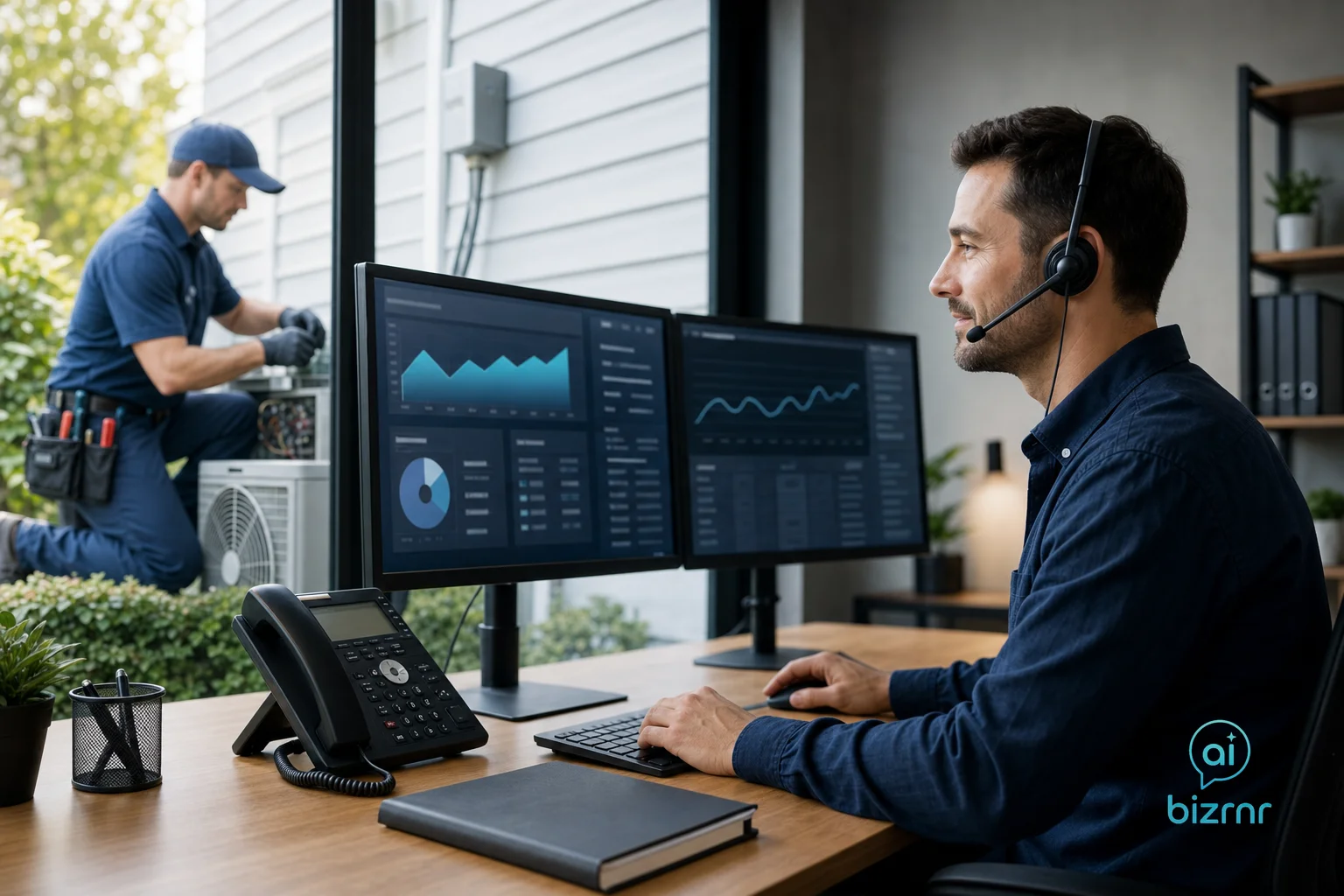
Every missed call in the HVAC business is a missed job. A homeowner's AC goes out at 9 PM. They call the first company they find. Nobody answers. They hang up and call someone else. That job — worth $300, $500, maybe $3,000 for a full system replacement — is gone forever.
This is not a rare event. It happens dozens of times a week at most HVAC companies. And most owners have no idea how much it is costing them.
This is the story of how one HVAC company stopped the bleeding and captured over $200,000 in revenue they were previously losing to voicemail and missed calls — using an AI phone answering agent.
The Problem: Calls Coming In at the Wrong Time
The company in this case study runs a mid-sized HVAC operation. They serve residential and light commercial customers. They had a solid reputation and a steady stream of inbound calls.
But they had a big problem: most of their calls came outside business hours.
HVAC emergencies do not follow a 9-to-5 schedule. Furnaces break down on Friday nights. Air conditioners fail on Saturday afternoons. Water heaters stop working on Sunday mornings.
Here is what their call data looked like before AI phone answering:
- 40% of inbound calls came after 5 PM or before 8 AM
- Another 15% came during lunch hours when staff was unavailable
- Calls during peak season (summer and winter) often went unanswered during busy periods
- Their voicemail box was full more often than not
The result? Potential customers were calling competitors. Jobs that should have been theirs were going elsewhere.
Research backs this up. [80% of callers who reach voicemail hang up and call a competitor](/tools/missed-call-roi). They do not leave a message. They do not call back. They move on.
What They Tried Before AI
This company was not ignoring the problem. They had tried a few solutions before switching to AI phone answering.
Answering service: They hired a third-party answering service for after-hours calls. The service was expensive — over $600 a month — and the quality was inconsistent. Agents did not know HVAC terminology. They could not qualify leads or book appointments. They just took a name and number and promised a callback.
On-call rotation: They tried having technicians take calls on a rotating basis after hours. Techs hated it. It burned them out. And a tired technician answering calls at midnight is not giving great customer service.
Better voicemail: They updated their voicemail greeting and checked messages more often. But the data is clear — most callers do not leave messages. You cannot call back someone who hung up.
None of these solutions solved the core problem: the phone needed to be answered by someone who could actually help, at any hour, every day of the year.
The Switch to AI Phone Answering
The owner heard about AI voice agents through an industry forum. He was skeptical at first. He worried the AI would sound robotic. He worried customers would hate it. He worried it would be complicated to set up.
He signed up for a free trial with BizRnR. The setup took less than 45 seconds. He was surprised.
The AI agent was configured to:
- Answer every call within two rings, 24 hours a day, 7 days a week
- Ask qualifying questions — what is the issue, how urgent is it, what type of system do you have
- Book appointments directly into the company's scheduling system
- Route emergency calls to the on-call technician immediately
- Collect full contact information so no lead was ever lost
The AI sounded natural. It used plain language. It did not confuse customers. In fact, most customers did not realize they were talking to an AI until they were told.
The Results: 90 Days Later
After 90 days, the owner pulled his call data and compared it to the same period the previous year. The numbers were striking.
Call answer rate went from 61% to 100%. Every single call was answered. No more missed calls during lunch. No more unanswered calls at 11 PM.
After-hours bookings increased by 340%. The AI was booking jobs overnight that would have gone to competitors before.
Average response time dropped to zero. Customers who called at 2 AM had their appointment booked before they went back to sleep.
Lead qualification improved. The AI collected detailed information on every caller. When a technician called back, they already knew the system type, the problem, and the urgency. Jobs were dispatched faster.
Over 12 months, the owner calculated the revenue impact:
- Recovered after-hours revenue: $143,000
- Recovered peak-season overflow revenue: $61,000
- Total captured revenue: over $204,000
That number tracks with broader research. Businesses that rely on phone calls lose an estimated $126,000 a year to voicemail and missed calls. For an HVAC company with higher average job values, that number can be significantly higher.
Why AI Phone Answering Works for HVAC
HVAC is one of the best fits for AI phone answering. Here is why.
High average job value. A tune-up might be $150. A new system install can be $8,000 to $15,000. Every missed call has a high cost.
Emergency demand. HVAC customers call when they have a problem right now. They are not browsing. They need help today. If you do not answer, they call the next number.
Seasonal surge. During summer and winter peaks, call volume spikes. Human staff gets overwhelmed. AI does not get overwhelmed.
Repeat customer potential. A customer who books one service call can become a maintenance plan customer worth $500 to $1,000 a year for years to come. Missing that first call means losing the lifetime value.
If you run an HVAC company and want to see how AI phone answering applies to your specific situation, visit our [HVAC industry page](/industries/hvac) for details on how BizRnR works for heating and cooling businesses.
What the Owner Says Now
We asked the owner what surprised him most about switching to AI phone answering.
His answer: the quality of the leads coming in overnight.
He expected the AI to handle simple calls. What he did not expect was that customers with big jobs — full system replacements, commercial contracts — were calling at night and getting booked before his competitors even knew those leads existed.
He also said his team was less stressed. They were not drowning in voicemails every morning. Appointments were already on the calendar. Technicians had better information before arriving at jobs.
"I wish I had done this two years ago," he said. "It paid for itself in the first week."
You can see what BizRnR costs and compare it to what you are currently losing at our [AI receptionist pricing page](/pricing/ai-receptionist-cost).
Frequently Asked Questions
Will customers know they are talking to an AI?
Some will notice. Most will not, especially in the first few seconds. The AI speaks naturally and stays on topic. Many customers say they prefer it because they get answers immediately instead of waiting on hold or leaving a voicemail.
Can the AI handle HVAC-specific questions?
Yes. The AI is configured with your business information, your services, and your terminology. It can ask about system types, describe your service offerings, and collect the details your technicians need before arriving on site.
What happens if a customer has a true emergency?
You set the rules. The AI can be configured to flag emergency calls and route them directly to an on-call technician via text or phone transfer. No emergency slips through.
How long does setup take?
BizRnR deploys in under 45 seconds. You do not need a developer or a long onboarding process. You can be live before your next missed call happens.
Does it work with my existing scheduling software?
BizRnR integrates with most common scheduling and CRM tools used by HVAC companies. Appointments book directly into your calendar in real time.
What does it cost compared to a human receptionist or answering service?
A full-time receptionist costs $35,000 to $45,000 a year in salary alone, not counting benefits. A third-party answering service can run $500 to $1,500 a month with inconsistent quality. BizRnR costs a fraction of either option and works around the clock without sick days or turnover. See the full breakdown on our [pricing page](/pricing/ai-receptionist-cost).
---
If your HVAC company is losing calls after hours, during lunch, or during your busiest seasons, you already know what it is costing you. The question is how long you want to keep paying that price. Start your free trial at [BizRnR](/auth/register) today — no credit card required, and you can be live in under a minute.